In the fast-evolving world of skincare, the quest for the fountain of youth has moved past marketing hype and into the realm of precision molecular biology. For decades, one name reigned supreme: Retinol. It was the undisputed heavyweight champion of anti-aging, the gold standard recommended by every dermatologist from Manhattan to Seoul.
However, a new challenger has emerged from the botanical world (Bakuchiol). Marketed as the “nature’s retinol,” it promised all the collagen-building benefits without the stinging, peeling, and redness that often accompany Vitamin A.
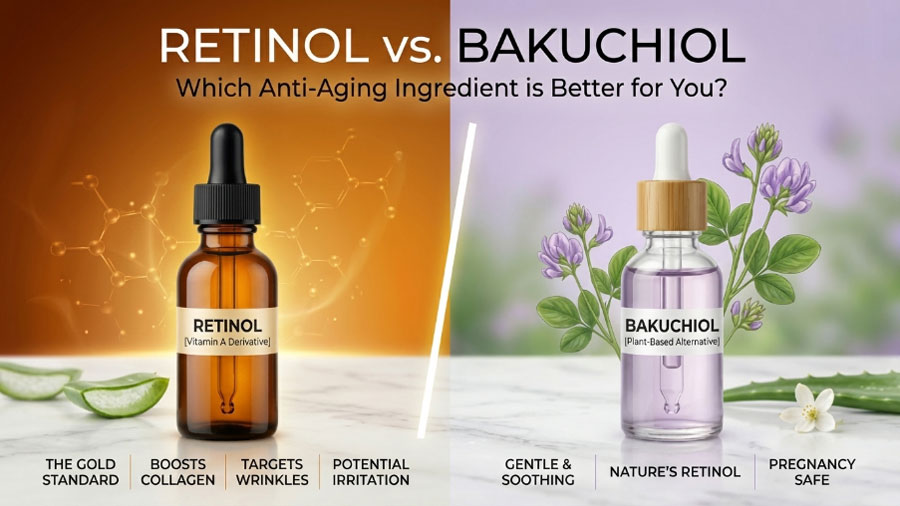
If you are currently standing in the skincare aisle, trying to decide which active ingredient deserves a spot in your nighttime routine, this is the only guide you need. We are breaking down the science, the side effects, and the ultimate verdict of Retinol vs. Bakuchiol to determine which one is actually “better” for your unique skin goals.
Understanding Retinol
Retinol is a derivative of Vitamin A. When applied to the skin, it undergoes a metabolic conversion process to become Retinoic Acid. This is the biologically active form that communicates directly with your skin cells.
How Retinol Works?
Retinol works on two levels. First, it exfoliates the surface of the skin, clearing away dead cells to reveal a brighter complexion. Second, it penetrates deep into the dermis (the middle layer of the skin) to neutralize free radicals and stimulate the production of collagen and elastin.
We refer to this as the primary tool for “Collagen Banking.” By increasing the rate of cellular turnover, Retinol ensures that your skin is constantly regenerating, effectively “pausing” the aging process by keeping the structural foundation of the skin dense and firm.
Advantages of the Retinol
- Clinical Dominance: Retinol has over 40 years of peer-reviewed clinical data backing its efficacy. It is the most studied anti-aging ingredient in history.
- Multi-Tasking Genius: It doesn’t just treat wrinkles; it is highly effective at clearing acne, shrinking the appearance of pores, and fading stubborn hyperpigmentation.
- Deep Structural Change: Unlike surface-level moisturizers, Retinol actually changes the way your skin behaves at a cellular level, thickening the deeper layers of the skin over time.
Disadvantages of the Retinol
- The “Retinol Ugly” Phase: Formally known as retinoid dermatitis, this is the 2-to-4-week period where the skin may peel, turn red, and feel extremely sensitive as it adjusts.
- Sun Sensitivity: Retinol makes your skin significantly more vulnerable to UV damage. If you aren’t diligent with SPF, Retinol can actually cause more aging than it prevents.
- Stability Issues: Retinol is notoriously “moody.” It degrades quickly when exposed to air or light, which is why high-quality packaging (like airless pumps) is a non-negotiable requirement.
Understanding Bakuchiol
Bakuchiol is a terpenoid phenol found in the seeds and leaves of the Psoralea corylifolia (Babchi) plant. While it has been used in Ayurvedic and Chinese medicine for centuries, its rise in modern dermatology only exploded in the last five years.
How Bakuchiol Works
Interestingly, Bakuchiol has no structural resemblance to Retinol. However, a landmark 2018 study published in the British Journal of Dermatology revealed that Bakuchiol functions as a retinol-analog. This means that even though it’s a different molecule, it triggers the same genetic pathways in the skin to upregulate collagen types I, III, and IV.
Advantages of the Bakuchiol
- Zero Irritation: Bakuchiol is inherently soothing. It does not cause the dryness, stinging, or flaking associated with Vitamin A, making it the “holy grail” for hyper-sensitive skin.
- Photostability: Unlike Retinol, Bakuchiol does not break down in sunlight. In fact, some studies suggest it may help protect the skin from UV-induced damage, making it safe for both morning and evening use.
- Pregnancy Safe: This is a major win. Retinol is strictly forbidden during pregnancy and breastfeeding due to the risk of birth defects. Bakuchiol is widely considered a safe alternative for expecting mothers.
- Natural/Clean Beauty: For those who prioritize plant-based, vegan, and eco-conscious formulations, Bakuchiol fits perfectly into a “clean” skincare lifestyle.
Disadvantages of the Bakuchiol
- Less Data: While the results are promising, we don’t have 40 years of data on Bakuchiol. We know it works for wrinkles, but we don’t yet know its long-term impact compared to decades of Retinol use.
- Slower for Acne: While it has anti-inflammatory properties, it isn’t as powerful as Retinol or Adapalene (Differin) for treating severe cystic acne or deep-seated blackheads.
- Purity Concerns: Because it is a plant extract, the quality of Bakuchiol can vary significantly between brands. You must ensure you are buying a product with at least 0.5% to 1.0% pure Bakuchiol to see clinical results.
Side-by-Side Comparison of Retinol and Bakuchiol
To help you decide, let’s look at how they stack up in the categories that actually matter to your mirror.
| Feature | Retinol (Vitamin A) | Bakuchiol (Botanical) |
| Wrinkle Reduction | High / Rapid | High / Gradual |
| Collagen Stimulation | Extreme | High |
| Skin Irritation | Common (Peeling/Redness) | Extremely Rare |
| Usage Time | Night Only | Morning & Night |
| Pregnancy Safe? | NO | YES |
| Best For | Oily, Acne-Prone, Mature Skin | Sensitive, Dry, Reactive Skin |
| Price Point | $ (Drugstore) to $$$(Luxury) | $$ (Mid-range to Luxury) |
Which is Better for YOU?
Skincare is never “one size fits all.” Your choice should be dictated by your skin’s current state and your lifestyle.
Choose Retinol If:
- You have oily or “congested” skin and want to treat acne alongside aging.
- You have deep-set wrinkles (45+) and need the most powerful intervention available over-the-counter.
- Your skin is “tough” and rarely reacts to new products.
- You are looking for the most cost-effective way to bank collagen.
Choose Bakuchiol If:
- You have sensitive skin, rosacea, or eczema.
- You are pregnant, nursing, or planning to become pregnant soon.
- You want an anti-aging routine that you can use in the morning under makeup.
- You prefer a plant-based, vegan approach to your beauty routine.
- You previously tried Retinol and had to stop due to the “purge” or excessive dryness.
Conclusion:
The argument shouldn’t be about which ingredient is better in a vacuum, but which one your skin can consistently tolerate. The secret to anti-aging isn’t the strength of the molecule; it’s the consistency of the application.
A 0.5% Bakuchiol serum used every single night for a year will yield far better results than a 1% Retinol cream that sits in your drawer because it makes your face sting.We have the luxury of choice. If you want the clinical power and have the skin for it, go for Retinol. If you want a gentle, steady, and safe journey to glowing skin, embrace Bakuchiol.